Production vibe coding

It is June 2026. AI coding is not going away, and given the current trajectory will only get more pervasive. Software engineering is not what it used to be just a few months ago. This post will likely be outdated before I hit publish. Let's go.
AI models can pretty much solve any trivial/medium and even "hard" task you throw at them. It's basically magic. Tests will pass, the functions will work, and the task will be "solved".
You see others shipping features at the speed of prompt and you want the same. You use the tools to your advantage, as you should.
Overtime, you're left with a strange feeling. You reflect and think, what did I learn these last months and nothing comes to mind. At least you shipped 100 new features, and rewrote your entire codebase. Improve, enhance, repeat.
How do you deal with this. Let's view a few scenarios, depending on how much you care.
The stages of caring
You don't care
You might look through the code on the surface and then say "looks good to me". Commit to main.
Job done. Let's go home.
Care a little bit
You care a little bit, you read through the code. This is code you know well. There are some minor changes here and there that don't look too dangerous on the surface. You ask yourself, is this an improvement? Maybe. Upon closer inspection, some tradeoffs you spent many hours thinking about are ignored. You might catch the ignored tradeoff, you might not. Ultimately, the feature is shiny. You say, "how bad can it be?" and commit.
You care a lot
You're different.
You care a lot. You take it slow. You look at your code in great detail. Inspect every change, hand-craft the architecture where needed.
Perfection achieved much faster than you could have done without these tools, but not quite at the speed of a prompt.
Teamwork
Let's assume we're all in the "you care a lot" camp.
You take a day off. Someone wants to implement a new feature and vibe codes all your carefully crafted perfection away. They "fix" a bug on code they don't understand.
All those hours you spent thinking about the pros and cons of various decisions along the way get lost to history for the sake of speed. At least the tests pass.
The price of good work
One used to have to work to produce something. Even something of poor quality. Now it is effectively free. Anyone can produce something and at first glance it looks acceptable. The barrier to entry is effectively zero. The barrier to reach the top is harder than before. The bar is higher and lower at the same time.
The people who can tell the difference between good and bad code are more powerful than before, just as a person who knows how to sew can identify what good stitching looks like on premium clothing.
The price of good work only increases as the need to filter out unlimited low quality output from someone takes more effort than they put into creating it.
It's not just coding
There are analogies to other industries.
Building has become more efficient than ever, but housing remains as expensive. Clothing has become cheap to make, but quality has deteriorated and it gets thrown away.
Vice coding fits perfectly into society today of fast fashion. Your code will only last the season before falling apart. Sometimes it just goes straight to the bin.
It makes things more accessible, but increases the amount of energy wasted along the way.
The vybe chicken is born
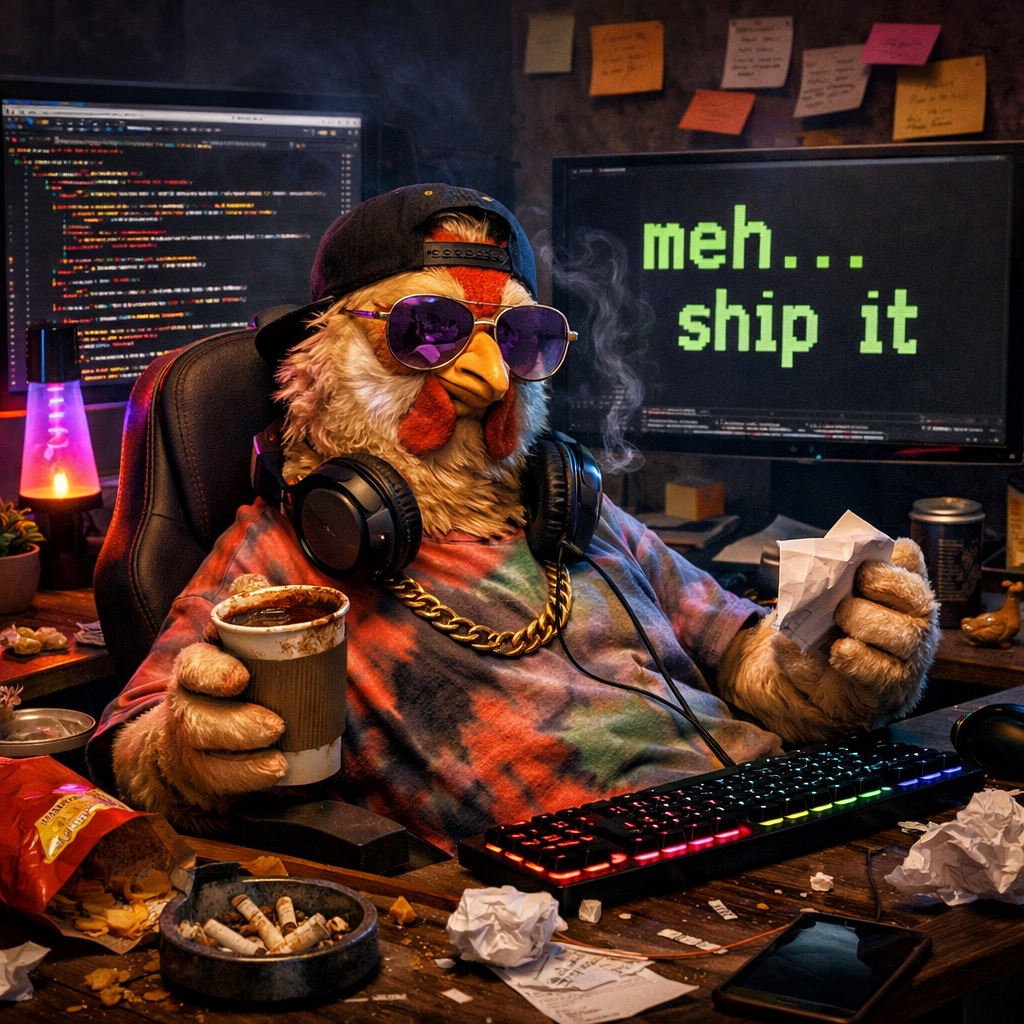
The flood of code has created the vybe chicken. Vybe chicken don't care. Vybe chicken ships 10 features a day.
Vybe chicken doesn't care about what thought others put into a bit of code. After all, the others probably didn't think, so why should it. Vybe chicken does what it's told, but no more.
After a while, vybe chicken spends its day only fixing bugs. Feature development slows down. Vybe chicken doesn't understand why.
This is the chicken's life. Vibe coding bugfixes for features which have been vibe coded. All to just ship it bro.
Where to
This is not a new problem. Everything and timelines have just been amplified, and without discipline will only get worse.
Humans have developed tools to help them since the dawn of time. Our tools get more advanced, and each comes with additional skills and education required to master them. At university, we learned fundamentals before we learned the higher level stuff. Not because it was useful, but we understood it was necessary.
I've very rarely needed to use the direct fundamentals in real life, but they still help one use the more advanced tools.
Currently, these models are no different. Sure for simple stuff it doesn't matter, and it's addictive to feel productive. Eventually everyone will catch up with what it really means to be productive given the current tools, and a balance will be found.
Or it doesn't matter as the models get so good and all these issues become irrelevant. Nobody knows.